The Pearson Vue Trick still "works" in 2026, but it changed: running it now means a real card and a real $200 charge, which people report coming back within hours on a pass. It's usually right, it's sometimes wrong in both directions, and it's folklore, not a result. The reliable route is $7.95 Quick Results two business days after your exam.
Let me be honest with you before anything else. I did the trick. The night after my NCLEX I could not sleep, I logged into Pearson VUE, I went through the re-registration screens with my heart pounding, and I got the good pop-up. Then my card got hit for $200 and I stared at my banking app for about two hours until the money came back. So I get it. I'm not going to tell you not to do it. I'm going to tell you exactly what you're doing, what it costs, and what I'd do now that I know better.
What the Pearson Vue Trick actually is: the good pop-up and the bad pop-up
The trick is simple, and it's not a feature. It's a side effect. Once a result gets recorded against your NCLEX registration, Pearson's system won't let you register for the same exam again. So people log back in after testing and try to re-register, on purpose, just to see whether the system blocks them.
- Wait until at least the next day. Trying a few hours after you finish is the number one cause of a wrong answer.
- Log into your Pearson VUE candidate account, the same one you registered with.
- Start the process to register for the NCLEX again, as if you were going to book a second date.
- Keep going until the system either stops you or asks for payment. What happens there is your "pop-up."
| What you see | What it likely means | What happens to the $200 | The catch |
|---|---|---|---|
| The "good pop-up." A message that reads: "Our records indicate that you have recently scheduled this exam. Another registration cannot be made at this time." | A result is already recorded on your registration, and in the large majority of reported cases that result is a pass. | A charge may still post. People report it coming back on its own within hours, with no new-exam email. Mine took about two hours. | Not official. A small number of people get this message and still fail. |
| The "bad pop-up." The system lets you through to the payment page. | Nothing is blocking a new registration yet. Usually that means a fail is on file, but it can also mean your result simply hasn't posted. | Nothing, as long as you stop here and never enter a card. | The less reliable of the two. Timing and glitches cause false bad pop-ups. Do not enter a card. |
| The registration goes through. Your card is charged and Pearson emails you a confirmation for a new exam. | The system accepted a brand-new registration, which it would not do with a pass on file. | Charged and kept. NCSBN's fee policy says duplicate registrations are not refunded. | This is the strongest bad sign the trick gives. It is also a $200 registration you just paid for. |
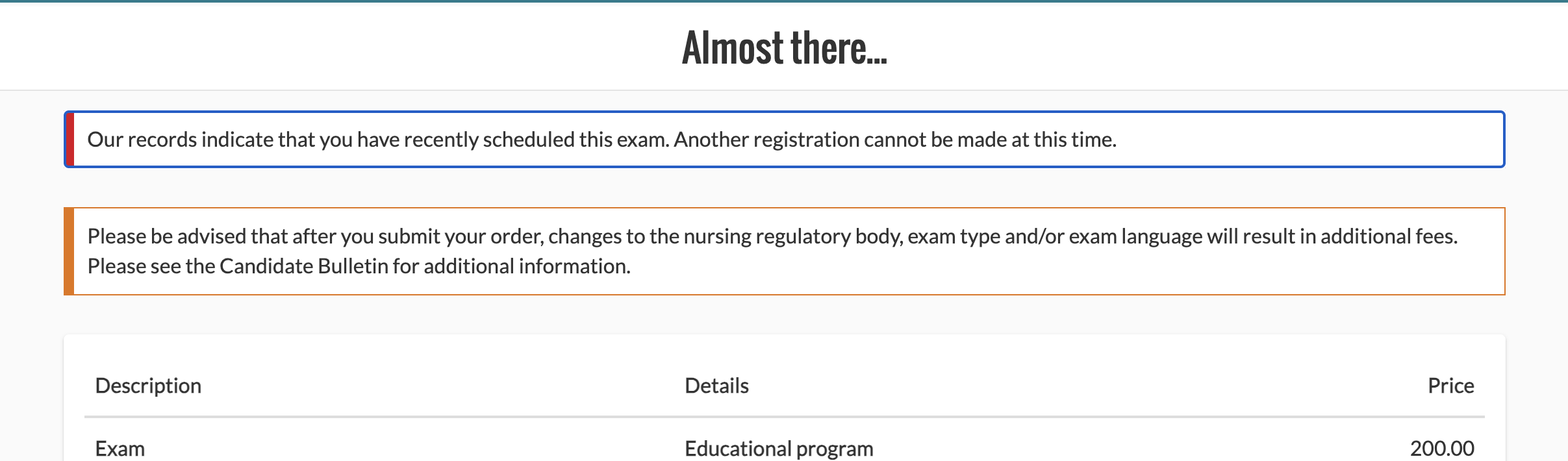
That's the whole trick. No secret menu, no code, no special link. It's a registration system doing what registration systems do, and a few hundred thousand nursing students a year reading meaning into it.
"Does the trick still work in 2026?"
Yes, the Pearson Vue Trick still works in 2026, but it changed. Running it now means a real card and a real $200 charge, which people report coming back within hours on a pass. It's usually right, sometimes wrong in both directions, and never official. The reliable answer is $7.95 Quick Results, two business days after your exam.
Yes, in the sense that the blocking behavior it depends on still exists. But the way you run it changed, and this is the part most of the older guides don't tell you.
For years, people ran the trick with a card that couldn't possibly be charged. A wrong security code, an expired card, a prepaid card with two dollars on it. The idea was that if you got the good pop-up you'd never reach the payment step, and if you got the bad pop-up the payment would just fail, so you'd learn your answer without risking a dime. As of 2026, candidates keep reporting that those shortcuts don't behave the way they used to, and that the honest way to see the trick through is with a real, funded card. Which means a real charge.
Here's the pattern people describe, and it's the pattern I lived. You get the good pop-up, or you get all the way to payment, and either way Pearson puts a $200 charge on your card. If you passed, that charge comes back on its own, usually within a couple of hours, with no email about a new exam. If it sticks, and a confirmation email shows up for a new test date, the registration actually went through, and that's the bad news. I want to be careful with my words here: that is reported behavior, from a lot of people over a lot of months, and it's what happened to me. It is not a documented Pearson policy. Nobody at Pearson or NCSBN has ever written down how the trick works, because officially there is no trick.
One more thing while we're on the money. NCSBN's own fees page says the registration fee goes from $200 to $350 on February 1, 2027. So the bet you're placing when you run this trick gets almost twice as expensive next year. Keep that in mind if you're reading this in 2027 and the number in your head is still $200.
"How accurate is it, really?"
You know where that famous "93% accurate" number comes from? Nobody does. I went looking. It's not from a study, it's not from NCSBN, and it's not from Pearson. It gets copied from blog to blog with "about 1,400 test-takers" attached, and none of them can point to where those 1,400 people were counted. NCSBN has never officially commented on the trick at all, one way or the other. It's folklore with a decimal point.
The only real dataset I've ever found is a community poll on the r/NCLEX wiki, checked in July 2026: about 130 people reported which pop-up they got and whether they passed. Of those, 92 got the good pop-up and passed, one got the good pop-up and failed, one got the bad pop-up and still passed, and 35 got the bad pop-up and failed. Add it up and the trick was right about 98% of the time for the people who bothered to answer a Reddit poll. That's encouraging. It's also 130 self-reports, which is not a study, and the people who got burned by it are not necessarily the ones filling out polls.
So here is the honest way to hold it. The good pop-up is a strong hint. The bad pop-up is a weaker one, because everything that goes wrong with the trick, testing too early, a slow update, a website glitch, a payment hiccup, pushes you toward a false bad pop-up, not a false good one. People post about a bad pop-up and a pass every single month. And every so often somebody posts the other one, a good pop-up and a fail, and that's the one that should keep you from celebrating until Quick Results says so.
"Will it charge my card?"
Yes. Plan on it. And read this next part twice, because it comes from NCSBN and not from Reddit. The NCLEX registration fee is $200, and their fees page says there will be "no refund of registration fees for any reason," and the list of examples they give includes duplicate registrations. A duplicate registration is exactly what the trick creates when it goes through.
So when people say the charge "gets refunded," understand what they mean. They mean Pearson's system reversed a charge on its own after it figured out you already had a result. That's a courtesy of the system, not a policy you can point to. If you pass, it has come back for basically everyone who's posted about it, including me. If you fail and the registration goes through, you paid $200 for a retake registration you may or may not have wanted on that date, and the policy says that money is committed.
Let me put it as plainly as I can. The trick costs $200 to run, and the real answer costs $7.95. You're betting two hundred dollars on a Reddit poll to find out something Pearson will tell you for the price of a sandwich, two business days later. That's the whole post, honestly.
What I'd do instead
Here are your four ways to find out, on one table, so you can pick like an adult and not like someone who's been awake for 20 hours.
| Option | Cost | When | How reliable | What it can't tell you |
|---|---|---|---|---|
| Pearson Vue Trick | $0 if you're blocked; a real $200 charge if it goes through | Next day, roughly | Unofficial. Usually right, wrong sometimes in both directions | Anything official. And it can cost you $200 |
| Quick Results | $7.95, charged only if a result is ready | Two business days after your exam | Unofficial, but it's Pearson's own system reporting your actual result. A pass here holds up | Your license. You still can't work off it |
| Your board's official result | Free | Up to six weeks by NCSBN's rule; most boards are faster | Official. The only one that counts | Nothing. This is the answer |
| Nursys license lookup | Free | The moment your board issues your license number | Official data, straight from your board | That you failed. It only shows a license that exists |
If I were sitting in your spot tonight, knowing what I know now, I'd skip the trick. I'd set a reminder for two business days out, pay the $7.95, and go to sleep. Quick Results is an actual Pearson VUE service, you order it inside the same candidate account, and your card only gets charged if a result is ready to show you. It's still "unofficial" on paper, because only your board can make you a nurse. But a Quick Results pass is your real result, just early, and I've never seen one get reversed. That's worth $7.95 and it's not worth $200.
Two things about Quick Results, because both trip people up. First, "business days" means business days. Test on a Friday and the weekend doesn't count, so you may be waiting until Tuesday. Second, it's only offered where your board participates. As of October 2026, Pearson's official list has every state except Delaware, plus D.C. and a couple of territories. California is on it, and the California RN board says so on its own FAQ. I couldn't find a matching statement from the vocational nursing board, so if you're a California PN candidate, don't take my word or anyone else's: log into your Pearson VUE account, and if the Quick Results option is there, your board participates.
Nursys QuickConfirm is a free license lookup run by NCSBN, and every state board reports into it, including LPN and LVN licenses. Search your own name. If a license number comes back, your board issued it, and you can stop refreshing anything. It won't tell you that you failed, only that a license exists. But when your name shows up there, it's over, and it's official.
The PN-specific wait
Most of what's written about NCLEX results is written for RNs, so let me say the PN part out loud. Everything above applies to the NCLEX-PN exactly the same way. Same Pearson VUE account, same trick, same Quick Results, same two business days, same $7.95. The difference is who sends your official result and how long they take, and that's your state's PN or VN board, not the RN board.
Take California, since that's where I tested. The Board of Vocational Nursing and Psychiatric Technicians posts its current NCLEX-PN results timeline on its own processing times page, and it updates that number, so go read the page instead of trusting a blog post's copy of it. NCSBN's own rule is that your board sends official results within six weeks. Most boards beat that by a lot. And as of the day I'm writing this, both California boards, the RN board and the VN board, are reporting into Nursys, so the free lookup above works for California PN candidates too. Once your license is issued you can also find yourself in the state's own DCA license search.
If your state isn't California, the shape is the same: your PN board's website will have a results or processing-times page, and your board will be on Nursys. Find those two pages the day after your exam and bookmark them. That's a better use of 2 a.m. than the trick.
Whatever the pop-up said
If you got the good pop-up, I'm happy for you, and I'd still wait for Quick Results before you tell everyone. If you got the bad one, I'm sorry, and I mean it. But it's the less reliable of the two, and people post about a bad pop-up and a pass constantly. Buy Quick Results in two days and believe that. And if Quick Results says fail, you take it again. Plenty of people do, and the second time usually comes with a real plan instead of a panic. When you're ready, the 30-day NCLEX-PN study plan is where I'd start, and the free practice questions are there for the daily work.
I truly believe the wait is the hardest part of this whole thing, harder than the exam for a lot of people, because at least during the exam you're doing something. Whatever you saw on that screen last night, your result already exists, it isn't changing, and you'll have it in your hands within days. Put the card away. Go to sleep. I'm rooting for you either way.
If your test also shut off at 85 questions and you're reading meaning into that number, I wrote a separate post on what the 85-question shutoff actually means, with NCSBN's own data. And the broader guide to every sign you passed the NCLEX covers which ones mean something and which ones don't.
FAQ
Does the good pop-up mean I passed the NCLEX?
Usually, but not officially. The good pop-up means Pearson's system is already holding a result against your registration, and in the large majority of reported cases that result is a pass. People have gotten the good pop-up and still failed, so treat it as a strong hint and wait for Quick Results or your board.
I got the bad pop-up. Is there any hope?
Yes. The bad pop-up is the less reliable of the two. Trying too soon, a glitch, or a slow update can all let you through to the payment page even when you passed. Do not pay. Wait two business days and buy Quick Results for $7.95, which comes from Pearson's own system and is what you should actually believe.
My card was charged and I got a confirmation email. What does that mean?
It means the re-registration went all the way through, and you now have a new NCLEX registration and a $200 charge that Pearson's policy says is not refundable. A charge that comes back on its own within a few hours with no confirmation email is the pattern people report on a pass. A charge that sticks, plus an email confirming a new exam, is the strongest bad sign the trick gives.
How soon after the NCLEX can I try the Pearson Vue Trick?
Most people wait until at least the next day. Trying within a few hours of finishing is the most common cause of a false bad pop-up, because your result may not have posted to the registration system yet. Quick Results, the official unofficial answer, opens two business days after your exam.
Does California offer NCLEX Quick Results for the PN?
California is on Pearson's official Quick Results participating list as of September 2026, and the California Board of Registered Nursing confirms its candidates can buy Quick Results two business days after testing. We could not find a separate statement from the vocational nursing board, so check your own Pearson VUE account: if the Quick Results option is there, your board participates. As of October 2026, Delaware is the only state not on the list.
How do I check if my LPN or LVN license has been issued?
Search yourself on Nursys QuickConfirm at nursys.com. It is free, it covers LPN and LVN licenses, and every state board reports into it, including both California boards. If your name comes back with a license number, your board issued it, which means you passed. You can also search your state board's own license lookup, which in California is the DCA search.
NCLEX® is a registered trademark of the National Council of State Boards of Nursing (NCSBN). Pearson VUE® is a trademark of Pearson Education. Passclex isn't affiliated with either. The Pearson Vue Trick is not an official service; neither Pearson VUE nor NCSBN has endorsed or documented it. Official facts, all re-verified September 7, 2026: fee, refund policy, and the February 1, 2027 fee change from NCLEX.com's Fees & Payment page; Quick Results price, timing, and participating list (list re-checked October 15, 2026) from NCLEX.com's Quick Results page; the six-week rule from NCLEX.com's Results page; California RN board participation from the BRN FAQ; Nursys participation from NCSBN's QuickConfirm participating boards list. The charge-and-refund pattern and the accuracy poll are community reports, from the r/NCLEX wiki and threads as of July 2026, plus my own experience; they are not Pearson or NCSBN data and can change without notice. This is the fastest-changing topic on this site, so the year in the title and the facts above get re-checked each quarter.